Satellites play a pivotal role in global missile detection and tracking by providing early warning, continuous monitoring, and precise data on missile launches and trajectories. Their capabilities are essential for modern missile defense systems, enabling timely responses to potential threats. Here’s an in-depth look at how satellites contribute to missile detection and tracking:
1. Key Roles of Satellites in Missile Detection and Tracking
A. Early Warning
- Detection of Launch Events:
- Satellites equipped with infrared (IR) sensors detect the intense heat signature of a missile’s exhaust plume during the boost phase.
- This early detection provides critical warning time to activate missile defense systems.
- Global Coverage:
- Satellites offer a continuous monitoring capability over vast regions, including remote or hostile territories where ground-based systems may not be deployed.
B. Trajectory Tracking
- Midcourse Tracking:
- Satellites monitor missiles during their midcourse phase as they travel through space, providing data for trajectory prediction and interception planning.
- Terminal Phase Updates:
- Satellites contribute real-time updates on re-entry vehicles during their terminal descent, aiding interceptor systems in targeting warheads.
C. Threat Assessment
- Trajectory Analysis:
- Satellites calculate the missile’s trajectory to determine its potential target and impact point.
- Decoy Identification:
- Advanced satellite sensors can distinguish between actual warheads, decoys, and debris, improving interception accuracy.
2. Satellite Types Used in Missile Detection and Tracking
A. Infrared Early Warning Satellites
- Purpose:
- Detect heat signatures from missile launches using infrared sensors.
- Examples:
- SBIRS (Space-Based Infrared System): Operated by the U.S. for detecting and tracking missile launches globally.
- DSP (Defense Support Program): Predecessor to SBIRS, providing early warning of missile launches.
- Advantages:
- Highly sensitive to heat signatures, enabling early detection during the boost phase.
B. Radar Satellites
- Purpose:
- Use synthetic aperture radar (SAR) to monitor ground activities and track missile movement post-launch.
- Examples:
- ESA’s Sentinel satellites and commercial SAR satellites provide supplemental tracking capabilities.
- Advantages:
- Operate in all weather conditions and can detect missile-related activities on the ground.
C. Hypersonic and Ballistic Tracking Space Sensors (HBTSS)
- Purpose:
- Specifically designed to detect and track hypersonic and ballistic missile threats.
- Features:
- Positioned in low Earth orbit (LEO) for closer tracking of fast-moving and maneuverable threats.
3. Phases of Missile Detection and Tracking via Satellites
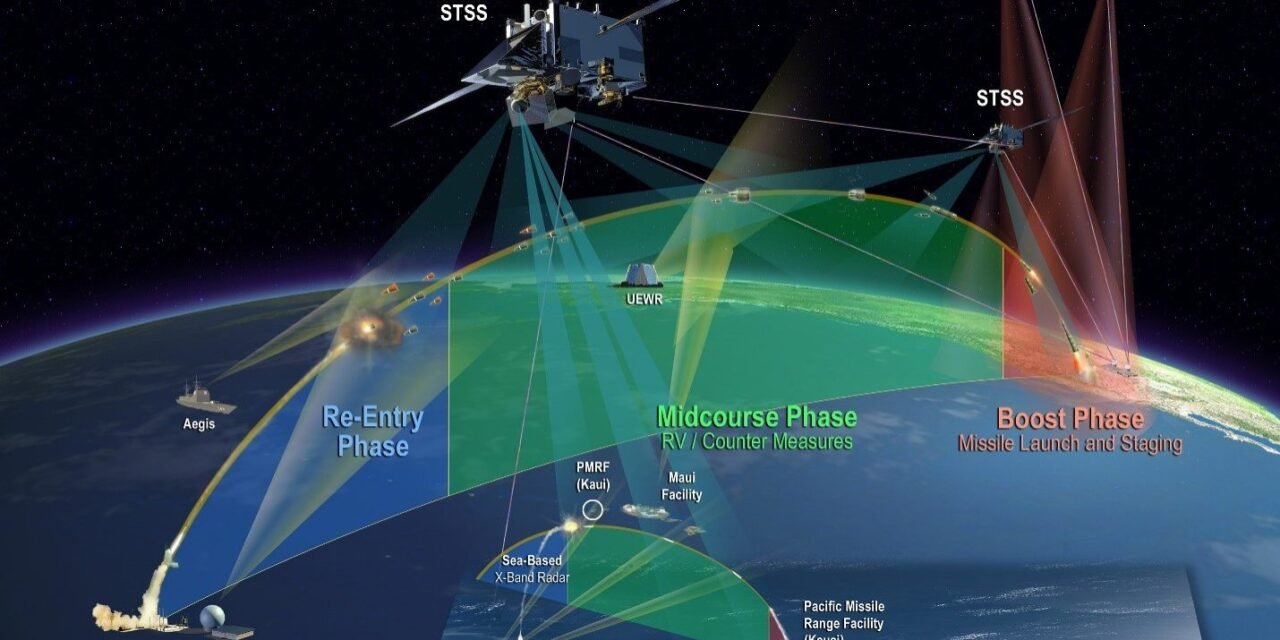
A. Boost Phase
- Detection:
- Infrared satellites detect the missile’s launch and exhaust plume during its powered ascent.
- Key Advantage:
- Heat signature is strongest during this phase, making it easier to detect.
- Limitation:
- The phase lasts only a few minutes, requiring rapid detection and response.
B. Midcourse Phase
- Tracking:
- Satellites monitor the missile as it travels through space, focusing on its trajectory and potential decoys.
- Key Advantage:
- Longest phase of the missile’s flight, allowing more time for tracking and analysis.
- Limitation:
- Detection of warheads among decoys can be challenging.
4. Integration with Ground and Sea-Based Systems
- Data Fusion:
- Satellite data is combined with radar and sensor information from ground- and sea-based systems for a comprehensive missile defense strategy.
- Command and Control:
- Early warning from satellites enables command centers to coordinate responses, including interceptor launches and civilian alerts.
5. Advantages of Using Satellites for Missile Detection
- Global Coverage:
- Can monitor areas that are inaccessible to ground-based systems, such as open oceans and enemy territories.
- Persistent Surveillance:
- Satellites provide continuous monitoring, ensuring no gaps in coverage.
- Rapid Detection:
- Infrared sensors detect missile launches within seconds, offering valuable reaction time.
- Decentralized Operation:
- Satellite networks are harder to disable compared to ground-based systems.
6. Challenges in Satellite-Based Missile Detection
- Hypersonic Threats:
- Hypersonic missiles are harder to track due to their speed, low-altitude flight, and maneuverability.
- Emerging solutions like HBTSS aim to address this challenge.
- Countermeasures:
- Adversaries may deploy decoys, stealth technology, or electronic warfare to evade detection.
- Latency:
- Data relay from satellites to ground stations can introduce delays, though advancements in processing are minimizing this issue.
- Space Debris:
- The growing threat of space debris can compromise satellite functionality and tracking capabilities.
7. Examples of Modern Satellite Networks for Missile Detection
A. SBIRS (U.S.)
- Infrared-based early warning system.
- Provides global coverage for missile launches.
B. HBTSS (U.S.)
- Designed to detect hypersonic and ballistic missile threats with high precision.
- Operates in low Earth orbit for close-range tracking.
C. GLONASS and Pion-NKS (Russia)
- Russia’s early warning satellites support national missile defense systems.
D. Yaogan Series (China)
- Used for missile detection, reconnaissance, and tracking in support of China’s defense capabilities.
8. Future Developments
- AI Integration:
- Artificial intelligence will enhance satellite data processing, enabling faster and more accurate threat detection.
- Proliferated LEO Constellations:
- Deployment of large satellite constellations in low Earth orbit to improve coverage and tracking of hypersonic threats.
- Laser Communication:
- Inter-satellite laser links will enable near-instantaneous data relay and improved global connectivity.