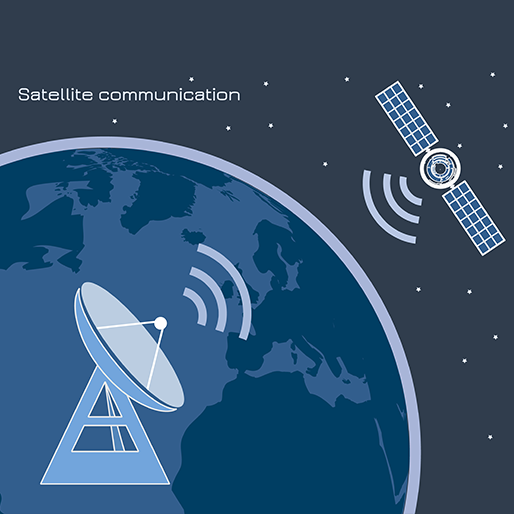
Satellites play a pivotal role in global communication and data transmission by enabling connectivity and data exchange over vast distances, including remote and inaccessible regions. Here’s how they contribute:
1. Global Connectivity
- Coverage Over Remote Areas: Satellites provide communication services in regions where terrestrial networks (e.g., fiber optics, cell towers) are unavailable, such as oceans, deserts, and rural areas.
- International Linkages: They serve as the backbone for transcontinental data transmission, linking continents through space-based communication networks.
2. Television and Broadcasting
- Direct-to-Home (DTH) Services: Satellites transmit television signals directly to users’ homes, ensuring high-quality broadcasts globally.
- Live Event Coverage: Satellites facilitate the live transmission of global events, including sports, news, and cultural programs, regardless of location.
3. Internet Access
- Broadband Services: Communication satellites provide high-speed internet access to remote and underserved regions, contributing to global digital inclusion.
- Low-Earth Orbit (LEO) Constellations: Emerging satellite networks like SpaceX’s Starlink and OneWeb offer global, low-latency internet services by deploying large constellations of LEO satellites.
4. Mobile and Fixed Communication
- Mobile Networks: Satellites support mobile communication services, enabling voice and data connectivity for mobile users worldwide, including in-flight and maritime communication.
- Backhaul Connectivity: They act as a critical link between rural networks and central hubs, supporting cellular and broadband infrastructure.
5. Emergency and Disaster Response
- Rapid Deployment: Satellites provide communication infrastructure during natural disasters, conflicts, or power outages when ground-based networks are disrupted.
- Search and Rescue: They support emergency response systems by transmitting distress signals and aiding rescue operations through precise location tracking.
6. Business and Enterprise Solutions
- Corporate Networks: Satellites enable private data communication networks for businesses with dispersed operations, such as oil rigs, ships, and global enterprises.
- Banking and Financial Services: They support secure data transmission for financial transactions and ATM networks in remote areas.
7. Scientific Research and Exploration
- Data Relay: Satellites transmit data from remote sensing satellites, space missions, and scientific instruments to ground stations for analysis.
- Astronomy and Earth Observation: Communication satellites help relay data collected by space telescopes and Earth observation missions.
8. Government and Defense Applications
- Secure Communications: Satellites support encrypted communication for military operations and government activities, ensuring confidentiality and reliability.
- Surveillance and Intelligence: They transmit data collected from reconnaissance and surveillance satellites to command centers.
9. IoT and Machine-to-Machine (M2M) Communication
- Global IoT Connectivity: Satellites enable the Internet of Things (IoT) by connecting devices across remote and mobile environments, such as agricultural sensors, transportation fleets, and energy grids.
- Telemetry Services: They facilitate M2M data exchange for monitoring and control applications in industries like oil and gas, shipping, and logistics.
10. Redundancy and Reliability
- Backup Communication Channels: Satellites provide redundancy for terrestrial communication networks, ensuring continuity during outages or infrastructure failures.
- High Availability: They deliver reliable communication solutions with minimal downtime, critical for essential services.
How Satellites Enable Communication
- Transponders: Satellites receive signals from ground stations, amplify them, and retransmit them to the intended receivers (uplink and downlink processes).
- Orbit Types:
- Geostationary Orbit (GEO): Fixed position relative to Earth, ideal for broadcasting and long-distance communication.
- Medium Earth Orbit (MEO): Used for GPS and regional communication systems.
- Low Earth Orbit (LEO): Offers low-latency and high-speed communication for global internet services.
- Frequency Bands: Satellites use different frequency bands (e.g., C-band, Ku-band, Ka-band) for various communication purposes.
Advantages of Satellite Communication
- Wide Coverage: Satellites can cover large geographical areas, including remote and underdeveloped regions.
- Scalability: Easy to scale services to new areas without extensive ground infrastructure.
- Mobility: Ideal for mobile platforms like aircraft, ships, and vehicles.
- Rapid Deployment: Quick setup compared to laying cables or building ground infrastructure.