Satellites are essential tools in modern space exploration and defense strategies, serving as versatile platforms for communication, observation, navigation, and scientific discovery. Their strategic importance spans civilian, military, and governmental domains, enabling technological advancements, enhancing global security, and expanding our understanding of the universe. Here’s a detailed look at their roles:
1. Role in Space Exploration
Earth Observation and Climate Monitoring
- Data Collection:
- Satellites equipped with sensors and cameras gather data on Earth’s weather patterns, ecosystems, and environmental changes.
- Example: NASA’s Landsat series monitors land use, deforestation, and agriculture.
- Climate Research:
- Satellites like the Sentinel series (Copernicus program) track atmospheric gases, ocean temperatures, and polar ice melt to understand climate change.
Space Science and Astronomy
- Observation of Celestial Objects:
- Space telescopes, such as the Hubble Space Telescope and James Webb Space Telescope (JWST), provide insights into the origins of the universe, star formation, and distant exoplanets.
- Exploration of Solar System Bodies:
- Satellites like Mars Reconnaissance Orbiter (MRO) and Lunar Reconnaissance Orbiter (LRO) provide high-resolution images and data about planetary surfaces, aiding future missions.
- Cosmic Phenomena:
- Observatories like Chandra X-ray Observatory study black holes, neutron stars, and other high-energy phenomena.
Communication for Space Missions
- Relay Stations:
- Satellites act as communication relays between Earth and distant spacecraft, ensuring seamless data transfer.
- Example: TDRS (Tracking and Data Relay Satellites) facilitate continuous communication with the International Space Station (ISS).
Navigation and Mapping
- Deep-Space Navigation:
- Navigation satellites help track interplanetary spacecraft and provide trajectory corrections.
- Example: Ground stations use data from navigation satellites to guide missions like Perseverance on Mars.
2. Role in Defense Strategies
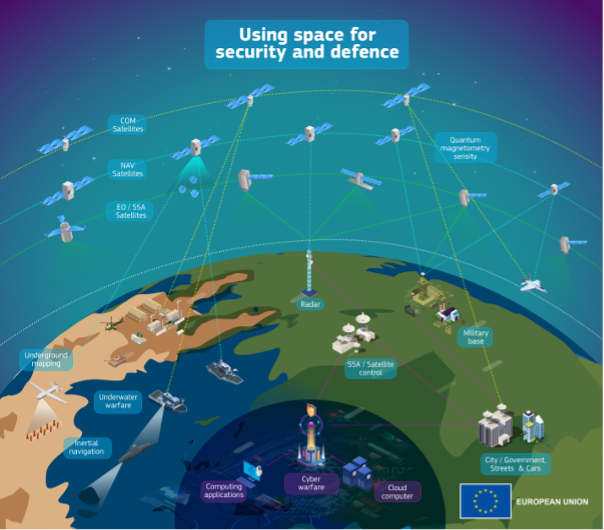
Intelligence, Surveillance, and Reconnaissance (ISR)
- Monitoring Global Activities:
- Military satellites provide real-time imagery and signals intelligence (SIGINT), tracking troop movements, missile launches, and naval deployments.
- Example: The KH-11 reconnaissance satellites offer high-resolution imagery for strategic military planning.
- Border Security:
- Satellites monitor border regions, detect smuggling activities, and track unauthorized crossings.
Communication and Coordination
- Secure Communications:
- Defense satellites enable encrypted communication for military forces, ensuring secure transmission of sensitive information.
- Example: The Advanced Extremely High Frequency (AEHF) satellite system provides secure communication for U.S. military operations.
- Global Connectivity:
- Satellites support communication in remote or contested regions where terrestrial networks are unavailable or compromised.
Missile Defense
- Early Warning Systems:
- Satellites equipped with infrared sensors detect and track missile launches in real-time, providing critical warning to defense systems.
- Example: The Space-Based Infrared System (SBIRS) detects ballistic missile launches and tracks their trajectories.
- Targeting and Guidance:
- Satellites enhance the accuracy of missile systems by providing precise location data and tracking targets.
Navigation and Positioning
- Global Positioning Systems (GPS):
- Defense forces rely on GPS for navigation, target acquisition, and coordination of troop movements.
- Example: The GPS III constellation enhances navigation accuracy and provides anti-jamming capabilities for military use.
Space Situational Awareness (SSA)
- Tracking Space Objects:
- Satellites monitor the positions of other satellites, space debris, and potential threats in orbit.
- Example: The U.S. Space Surveillance Network (SSN) uses satellites to track objects in Earth’s orbit.
- Collision Avoidance:
- SSA helps prevent collisions between satellites and other objects, ensuring operational safety in crowded orbits.
3. Strategic Importance in Dual-Use Applications
- Civilian and Military Integration:
- Many satellites serve both civilian and military purposes, such as weather monitoring and secure communications.
- Example: The Copernicus program supports both environmental monitoring and disaster response for defense purposes.
- Disaster Response:
- Satellites provide rapid assessments of natural disasters, enabling efficient mobilization of resources for rescue and recovery.
- Example: During floods or earthquakes, satellites deliver real-time imagery to aid relief efforts.
4. Enabling Technological Advancements
- Miniaturization and CubeSats:
- The rise of small satellites and CubeSats has enabled cost-effective deployment of satellite constellations for defense and exploration.
- Example: Swarm technologies use multiple small satellites to enhance data coverage and redundancy.
- Artificial Intelligence (AI) and Automation:
- AI enhances satellite data processing, enabling faster analysis and decision-making for defense and exploration.
- Example: AI-powered satellites autonomously adjust their operations to optimize data collection.
5. Challenges and Risks
Space Debris
- Increasing numbers of satellites pose collision risks, potentially disrupting defense and exploration missions.
Cybersecurity Threats
- Military satellites are vulnerable to hacking and jamming, jeopardizing their reliability during conflicts.
Space Weaponization
- Growing competition among nations to develop anti-satellite weapons (ASAT) increases the risk of conflicts in space.
Conclusion
Satellites play a pivotal role in modern space exploration and defense strategies by enabling precise navigation, robust communication, advanced surveillance, and groundbreaking scientific research. As technology evolves, satellites will continue to drive innovation, enhance global security, and support humanity’s quest to explore the cosmos. Balancing these capabilities with the challenges of space debris, cybersecurity, and militarization will be critical to ensuring sustainable and peaceful use of space.
Hashtags
#SatelliteTechnology #SpaceSatellites #SatelliteInnovation #AerospaceSatellites #SpaceTech #ExplorationSatellites #LunarOrbitSatellites #DeepSpaceSatellites #MarsMissionSatellites #AsteroidObservation #SatelliteForDefense #MilitarySatellites #EarthObservationSatellites #CommunicationSatellites #NavigationSatellites #SustainableSatellites